

【 THE RISE AND REIGN OF THE MAMMALS 】
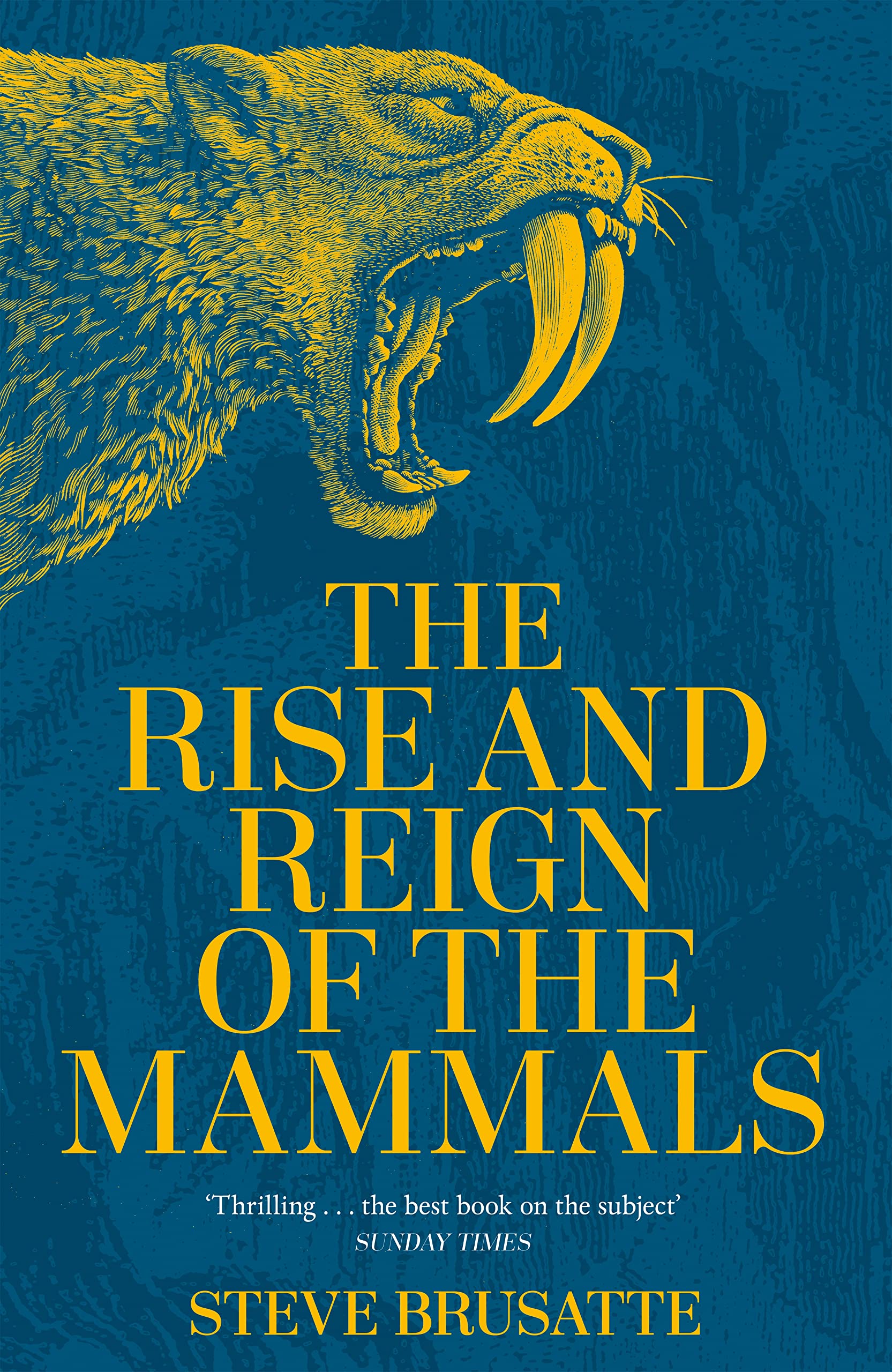
Genre: Non-Fiction (environmental science)
Audience: Adult
Author: Steve Brusatte
Published: June 2022
Publisher: Picador
Pages: 528 (hardback)
You might not think that a humongous book about the evolution of mammals could be your favourite read of the year so far, but I’m here to tell you that it’s very possible. I have collected some of my favourite little quotes from the book for you all to enjoy, speckled throughout this review.
I have loved many non-fiction books recently on environmental science, and I was really curious about how I would go with this. Up to this point, my niche obsession has focussed largely on trees (looking at you, The Hidden Life of Trees), so when I decided to expand my scope from just trees to the entire mammalian evolutionary history, I thought there was a chance I might have dived into the deep end.
But never fear, because Brusatte was there to warmly introduce me into this much broader world of science, inundated with Latin names, by explaining all the complexities in perfect, relatable ways.
“These were the finishing touches in the making of mammals after a long process of evolutionary assembly, the last Lego pieces to complete the castle.” (p. 64)
Accompanying the absolutely fascinating facts and tidbits in this book, is his witty, wry humour, and Brusatte’s personal tone throughout makes this a delight to read. Every page is engaging and science has never been more exciting. Or funny!
“Like many writers, Walter Kühne did some of his best work while in prison.” (p. 51)
My mind is abuzz with all the things I learnt. I will say this is 100% a crash-course/baptism of fire when it comes to teeth. I can’t say I’d’ve ever said teeth could be interesting before now. But learning how horrifyingly gigantic rodent incisors are, or the weird conveyor-belt-like behaviour of elephant teeth, and not to mention the super tall teeth of horses, has proven me wrong. It’s page-turning stuff.
Brusatte really has a way with words, but even more than that, he has a way with spectacularly unexpected metaphors. And speaking of horse teeth, one of my favourite examples of this was while he was talking about them:
“… so much of it remained hidden inside the gums and jawbone, gradually erupting over the life of the animal like the lead in a mechanical pencil.” (p. 304)
This book will really get you thinking about evolution and all the cool things that have happened since our oldest ancestors up to right now in the present – the strange and funny features that various species trialled and tested to see what would work best.
“Over time, the system was fine-tuned by natural selection, turning a 1990s Game Boy, of coarse graphics and limited capability, into a modern gaming console.” (p. 264)
And what truly blew my mind, is seeing this all through the eyes of a palaeontologist – I don’t think I could ever have the patience to do what they do. While riveting, there is no doubt this is an excruciating puzzle-like career where not only are you not given a reference picture, but your puzzle pieces are scattered on the wind, and you’ve got to find those too. It’s mind-boggling to think of the immense amount of research that has gone into not only understanding the fossils, but what the world around that animal looked like based on what features it had developed to adapt to its environment.
“Two realms separated for over 100 million years were now connected by a migration super-highway, and many streamed across in both directions, mixing and mingling like easterners and westerners in those frenzied moments after the fall of the Berlin Wall.” (p. 335-336)
I’ve even got a new bucket-list item out of this book: the Rhino Ashfall Fossil Beds in the USA. There were numerous amazing stories like this, but this one really stuck with me. A unique preservation/collection of fossils that captures herds of animals (namely rhinos) due to a volcanic eruption. All contained within this shed that is open to the public and where you can watch real-time as scientists continue to excavate the many, many fossils at the site. Go look it up, it’s so cool!
It was quite a fun geographical and geological jaunt, too! I’ve always liked these sorts of things, but to capture the forming and reforming of the continental plates and the march of the glaciers all in one book created a glorious big-picture effect.
“Mostly horizontal, that is. After all, these continental ice sheets were not smooth and featureless, like some perfect layer of frosting draped atop a cake.” (p. 331)
And there is a sobering element to this book, too. Of course, as Brusatte works his way through the ages and eventually reaches humans, it throws our actions and impact on climate change into a harsh light. The comparisons given on the speed of global warming now versus during any prior warming events, were scary and unsettling. Yet, this was all very important to understand, too.
So, I highly recommend this. To absolutely everyone. You will learn a lot, and I promise (whether it seems hard to believe or not) that you’ll laugh even more.
“Roaring–in addition to being petrifying–is how social cats communicate.” (p. 357)

You may also like …

Title: The Rise and Reign of the Mammals
Author: Steve Brusatte
Add it on Goodreads
The passing of the age of the dinosaurs allowed mammals to become ascendant. But mammals have a much deeper history. They – or, more precisely, we – originated around the same time as the dinosaurs, over 200 million years ago; mammal roots lie even further back, some 325 million years.
Over these immense stretches of geological time, mammals developed their trademark features: hair, keen senses of smell and hearing, big brains and sharp intelligence, fast growth and warm-blooded metabolism, a distinctive line-up of teeth (canines, incisors, premolars, molars), mammary glands that mothers use to nourish their babies with milk, qualities that have underlain their success story.
Out of this long and rich evolutionary history came the mammals of today, including our own species and our closest cousins. But today’s 6,000 mammal species – the egg-laying monotremes including the platypus, marsupials such as kangaroos and koalas that raise their tiny babies in pouches, and placentals like us, who give birth to well-developed young – are simply the few survivors of a once verdant family tree, which has been pruned both by time and mass extinctions.
In The Rise and Reign of the Mammals, palaeontologist Steve Brusatte weaves together the history and evolution of our mammal forebears with stories of the scientists whose fieldwork and discoveries underlie our knowledge, both of iconic mammals like the mammoths and sabre-toothed tigers of which we have all heard, and of fascinating species that few of us are aware of.
For what we see today is but a very limited range of the mammals that have existed; in this fascinating and ground-breaking book, Steve Brusatte tells their – and our – story.

Discover more from Upside-Down Books
Subscribe to get the latest posts sent to your email.
 Upside-Down Books